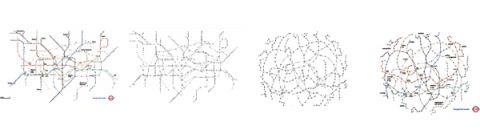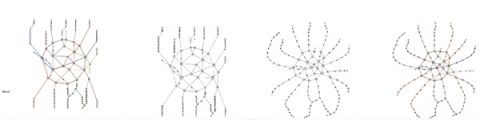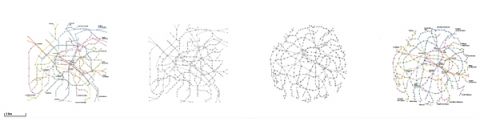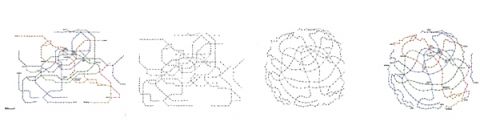
Subway Sorter
Subway Sorter – study project, New York City, 2008 / Aurel von Richthofen, based of a Java-based program written by David Rutten
The design research leading to Subway Sorter is rooted in an ongoing interest in the representation of traffic - here in the form of public underground transportation - as a means of psycho-geography of the city. The congested surface of Manhattan Island forces its inhabitants to use the antiquated underground system. A short historical survey shows that the present underground system is the result of projects by several competing private transport companies. In good capitalist manner each of these companies served specific boroughs with the financial and commercial center in the early 20th century. Thus the system radiates linearly from downtown and midtown Manhattan to Upper East- and Westsides, Brooklyn, Queens and the Bronx without many connections. The linear transportation proved highly efficient and lead to a New York specialty of local and express trains sharing the same lines. As a means to connect boroughs and center, this system was a marvel. With the transformation of neighborhoods and relocation of financial and commercial activities, the system is on the verge of collapse.
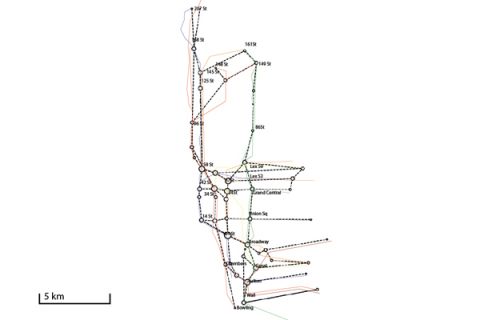
Or is it? When these companies merged to the current Metropolitan Transport Administration in the 1960ies little was done to overcome the separation of the systems. In a demonstrative move the first map shows a unified and color-coded subway network mapped on the super-terrestrian geography of the city. As a result New Yorkers and visitor alike regularly experience the frustrations of a subway system that is almost un-intelligible. The 1972 map was an attempt to overcome geographic fidelity in favor of radical graphic abstraction. The 72 map shows lines running orthogonally and in 45* angles. Central Park had shrunk to a green square and the red 1,2,3 lines meeting at Columbus circle had been placed west of the B,C,D,E lines instead of east for the sake of graphic consistency. No wonder this graphically pleasing map found little recognition with Manhattanites using it and was replaced a few years later with the previous map. What made the New York subway system incomprehensible was the representation as a single geographic entity. Neglecting its legacy the map was neither usable above nor underground.
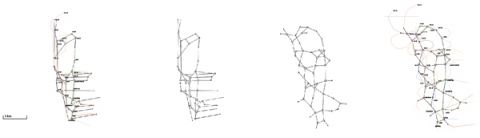
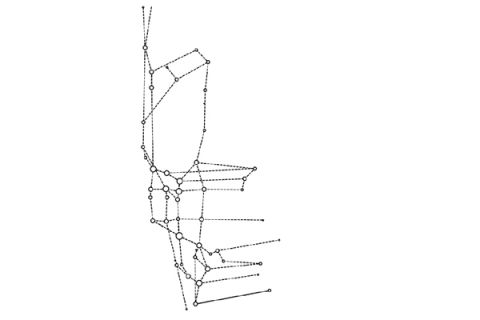
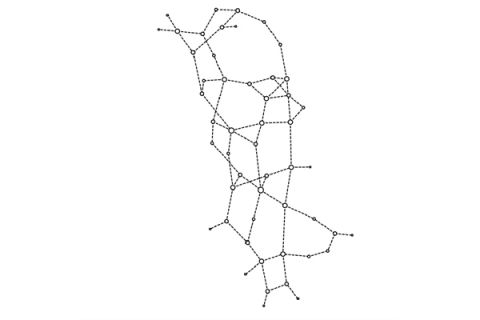
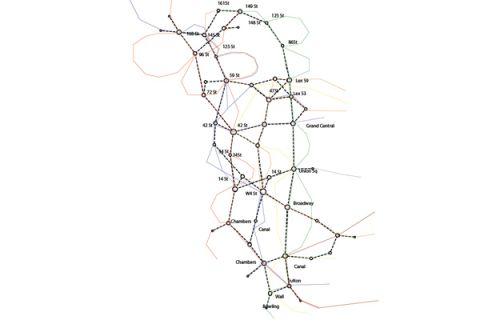
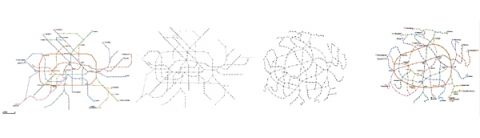
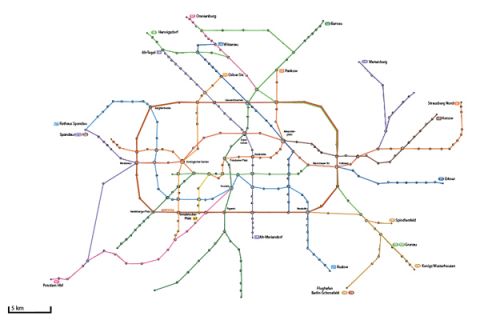
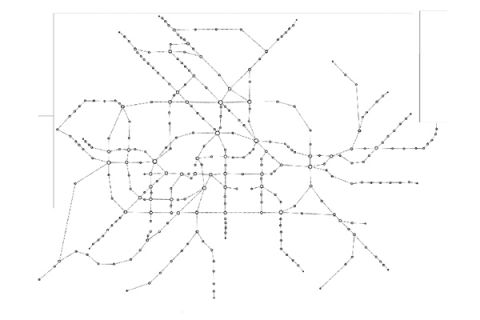
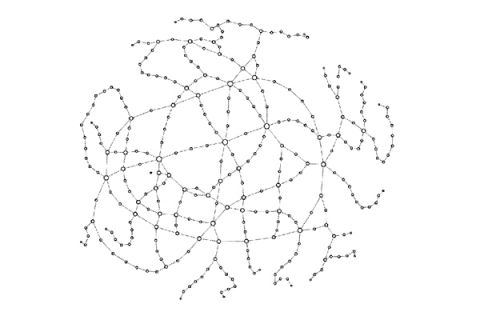
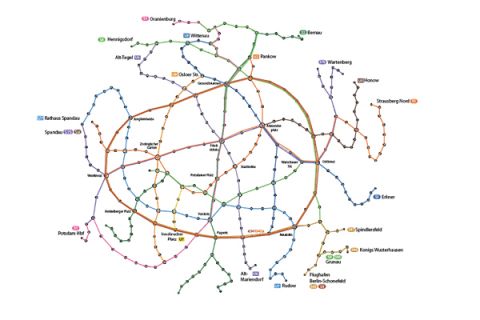
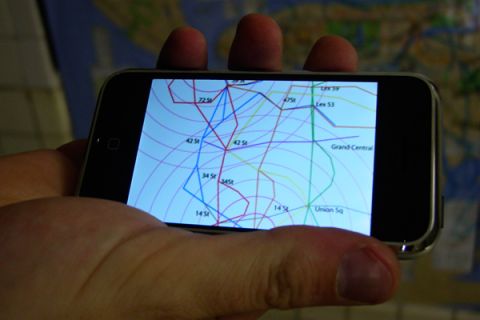
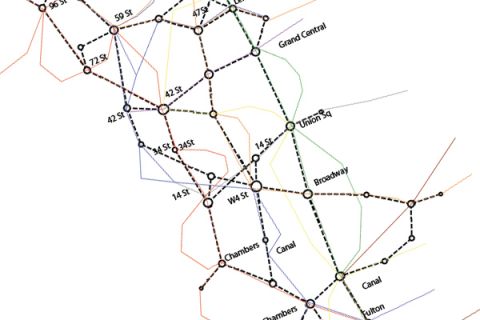
Subway Sorter is based on the idea that most essential information to the user is time. A subway user entering the system will know that approximately where to surface. What he or she does not care about is what intricate the turns the trains will take underground, leaving it to speculation whether to change in one station or the other. Ultimately one wants to know when the excruciating trip will reach its destination and one would like to know what the most efficient connections are. Subway Sorter inputs the New York subway system and re-organizes each segment on a time based scale. As the geography distorts a new map appears: Connection nodes between lines tie the system together, local stops in a line bulk out while the space between express stops shrinks, the linear shape of Manhattan inflates and wedges around the radiating satellites of Brooklyn, Queens and the Bronx.
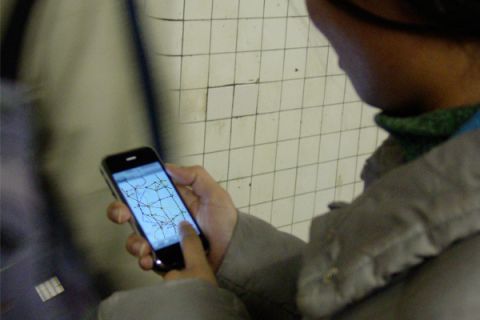
Implemented as an iPhone application in alpha stage Subway Sorter feeds on live mta data. Localization through GPS and antenna triangulation tracks the users position. The map re-adjusts and computes time and connections in a single dynamic map.